
1
Connect
Every scattered source, from the ERP to the clipboard, pulled into one data warehouse you own.


Paloma connects your entire operation into a single, living source of truth, diagnoses the gaps, and continuously runs improvements.

01 / How it works
Paloma builds your modern data infrastructure, then works like a team you didn’t have to hire. Not a tool to learn. Not a project to manage.
Connect
Every scattered source, from the ERP to the clipboard, pulled into one data warehouse you own.

Understand
How the operation actually runs, where the exceptions sit and which gaps cost you most, ranked in the order they pay off.

Improve
Alerts, analyses, agents, internal tools, whatever closes the gap. Every fix is built in, so the gains compound.
02 / Proof

“Between wasted logistics spend and time lost to reporting, we didn’t know how much money was walking out the door every month.”
$300K+/yr
Wasted logistics spend
$270K/yr
Margin lost to errors
3 days/mo
Spent on reporting, per operator
03 / The problem
Your ERP has half your data, at best. The rest lives in spreadsheets, WhatsApp threads, clipboards, and your team’s heads.
Problems get caught late, or worse, you find out at the same time as your customer.

The biggest AI wins of the next decade won’t happen in tech companies. They’ll happen in factories, fleets and warehouses — where the inefficiency actually lives.
We believe every operational company should run the way the best tech companies run: one living source of truth, decisions in minutes, AI doing the heavy lifting. What’s missing isn’t the AI. It’s the foundations underneath it. That’s what we build.
04 / What we do
Your business is fragmented
ERP
Orders · Inventory · Suppliers
Spreadsheets
Forecast.xlsx · Costs.xlsx
Supplier updates · Exceptions
Reports
Production · Logistics
Paloma understands it
Definitions
Business context
Rules
Ask anything
Why did logistics costs increase?
Retrieved 842 shipments
Matched carrier invoices
Applied logistics-cost definition
Compared May → June
12.4% increase, driven primarily by higher freight rates and expedited shipments from Factory B.Here is exactly how I know →
Visualize your operation
Ask anything
Create reports
Create dashboards
Create tools
Inspect the work
Sources
ERP · 842 shipments
Carrier invoices · 126 records
Logistics costs.xlsx
Calculation
Freight rates
+6.2%
Expedited shipments
+4.1%
Other
+2.1%
Total
+12.4%
Definition used
Logistics cost = Freight + handling + customs - customer reimbursements
Calculated from source data
Take action
Create monthly logistics report
Paloma will prepare a report based on the latest logistics data and analysis.
Includes: cost performance, key drivers & exceptions, factory breakdown, month-over-month trends
July logistics review updated with data through Jul 31, download the report
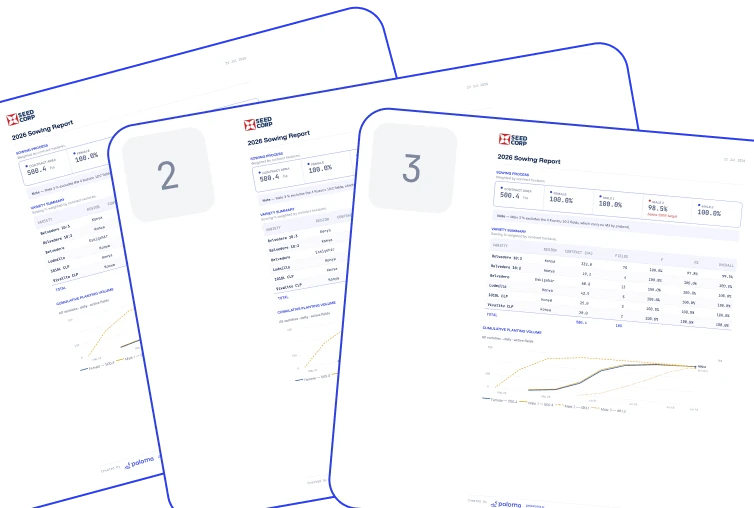
Skip the busywork
Order requests land by email or spreadsheet, in whatever format the sender used — Paloma reads them, maps every field to the ERP's structure, and creates the order.
Build what you need
Live schedule
A live control tower that re-sequences every line the moment something changes — a machine goes down, a rush order lands — instead of a planner reworking a spreadsheet by hand.
05 / See it in action
Chat, reports, dashboards — the same operational intelligence, however you like to look at it.
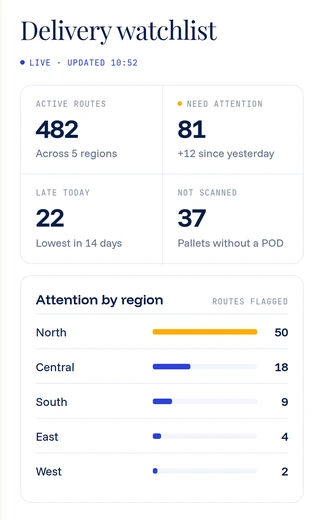
Live dashboards
Every route, every region, updated as it happens. Paloma flags what needs attention before it becomes a problem, so nothing slips through on a busy day.
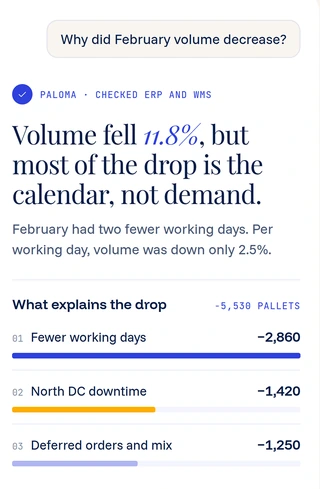
Ask, in plain language
Ask a question the way you'd ask a colleague, and get a straight answer sourced from your own systems — with the reasoning shown, not just the number.
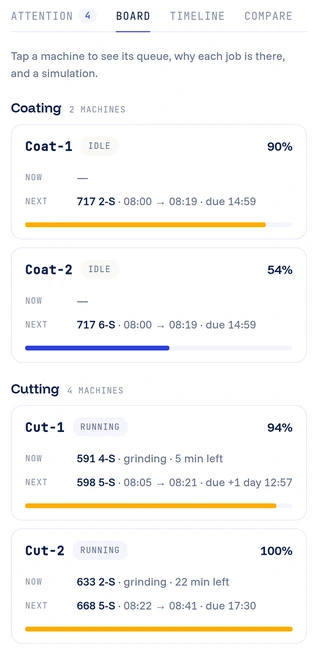
Machine board
Every machine's queue, in order — what's running, what's next, and why. The same live board your team works from, not a report about it.
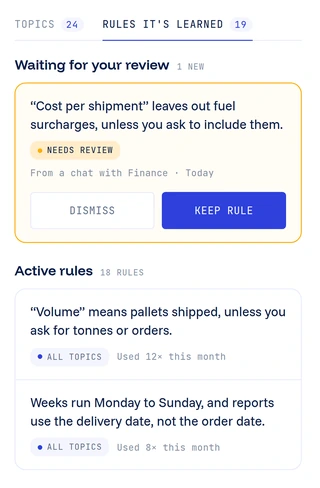
It learns your rules
Paloma picks up on how your team actually works — what "volume" means, which week starts when — and checks with you before it assumes anything new.
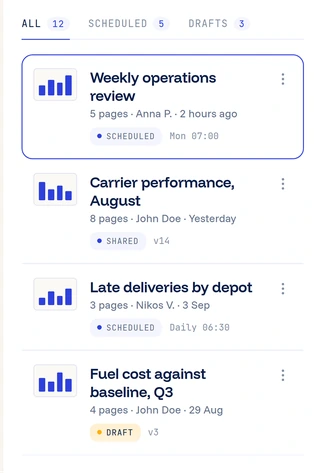
Reports that build themselves
Scheduled, shared, or still in draft — every report your team relies on, generated and delivered on time, without anyone chasing it down.
06 / Speedrun your AI adoption
Build a website in a minute, draft an email faster, but that doesn’t improve a production schedule, a late shipment, a month-end close. That takes knowing your own data, your own orders, your own Monday morning.
Your team knows exactly what’s broken. They just can’t judge what’s possible with today’s technology. So every first deployment starts by training them on how AI actually works, until it stops being a puck you chase with a six-month delay and becomes one you’re already waiting for.

Hire us for a week
07 / AI you can trust
We learn how your business actually runs, then teach the system your terminology, your logic, your way of working. It learns on the job — the longer it runs, the sharper it gets.

When it says logistics costs went up 12%, you see which sources it pulled from, how it calculated the number, and every step it followed. Logged, timestamped, attributed.

Dedicated infrastructure, encrypted in transit and at rest. Model access runs under zero-retention enterprise agreements — your data is never stored by the providers and never used to train their models.
Ask from WhatsApp on the shop floor, or pull a report from the desktop. It runs autonomously where you’ve approved it and waits for sign-off where you haven’t. A new hire you train over time — you decide what it’s trusted with.
That’s what the diagnostic call is for. Free, under an hour. Bring us the mess and we’ll untangle it together.
“I can’t quite put it into words yet” is a fine place to start. You talk, we listen, and at the end you get an honest answer on whether the week is worth it. If it isn’t yet, you’ll leave knowing exactly what to do first. You’re not behind. The map just hadn’t been drawn for companies like yours.
08 / FAQ
Our pricing is based on what we build, not how long it takes — so our incentive is to deliver fast, not to extend the engagement. You get functional tools within weeks, not a report after months.
Both are real progress, but each has a ceiling. RPA handles isolated tasks well but struggles with flexible, end-to-end workflows and breaks easily when systems change. ChatGPT generates content effectively but can’t move data between systems or take action on it. Paloma is integration software that understands your whole workflow, routes information where it needs to go, and executes the actions itself.
We build on top of your current systems, not instead of them. We start with read-only access and build in parallel — your regular operations continue unchanged until the new tool is ready and your team has validated it themselves.
We sign an NDA before touching any data, and access permissions are agreed and documented up front. During the pilot we work with read-only access — every output is an export or a report, never a write back to your ERP. Your IT team reviews the full access framework before anything begins.