
How it works
The intelligence behind your operation.
Paloma gives your business the data infrastructure of a tech company, then gets to work like an in-house operations analyst. Not a BI tool your team has to master. Not a consulting project that concludes with a deck.
Book a demo →

01 / Built to understand your business
Your operation, connected into one nervous system.
Right now your business runs on pieces that don't talk to each other. The ERP knows the orders. A spreadsheet knows the shipping costs. WhatsApp knows why the truck is late. Your best people carry the rest in their heads. Each piece works. Together, they can't answer a question.
Paloma is the nervous system that connects it all. Every source feeds one living base of real-time, transparent data that you own, and everything we build for you runs on top of it. Not another system to reconcile. The place where your company's knowledge finally centralizes, and starts to power something.
An operations team that never clocks out
Paloma watches the whole operation, 24/7. The data is there whenever you want to look, and when you don't, Paloma looks for you: digging on its own, pulling your attention to the number that moved, and surfacing where the next improvement is hiding.
Whatever it finds, Paloma either builds itself or adds to the roadmap: a morning report that lands in WhatsApp before the shift starts, an alert when a cost crosses its baseline, an agent that moves orders from email into the ERP, an internal tool built around one team's job. All of it running on the same base, sharing the same context.
Every build leaves your company more self-sufficient than it found it: your team's literacy grows, the system takes over more of the routine, and the improvements start coming from inside. We kick-start the engine. It keeps getting better whether we're in the room or not.
Knowledge that compounds
Paloma learns on the job and never forgets. What procurement teaches it, logistics inherits, and every build lands faster than the last. Knowledge like that used to live in someone's head and left when they did. Now it belongs to the company.
Built by engineers who actually understand your business
We embed with your team and learn how your operation runs. Not the org-chart version. The real one, where a purchase order gets confirmed by a WhatsApp voice note saying "boss confirmed, 400 tons, same price," and shipping costs live in a shared Excel with the suspicious ones highlighted in yellow. The terminology, the workarounds, the ten exceptions that make every "simple" process complicated.
That understanding gets encoded into the platform as its starting point. Seeding it is our job. Growing it is yours. From the first build, the system is set up so your team can keep teaching it in the flow of work, and the vocabulary and knowledge keep expanding without an engineer in the room.

- A morning report that lands in WhatsApp before the shift starts.
- An agent that moves orders from email into the ERP.
- An alert when a cost crosses its baseline.
- An internal tool built around one team's job.
02 / the process
What it's like day to day.

Answers on demand
“How many trucks did we ship to X customer this week?” becomes a 30-second query. “What if we moved product line 3 to the other facility?” gets a grounded answer, not a feasibility study three teams work on for a month. Every answer shows its sources and its calculations. Chat, voice, WhatsApp — however you prefer to work.

Investigations that go deeper
Not every question has a 30-second answer, and the best ones haven't been asked yet. Paloma runs proactive analyses, 2–3 a month: the cost that's been drifting for weeks, the exception that's quietly becoming the rule, the thing nobody thought to look at.

Capabilities that stay
When the same question keeps coming back, it stops being a question and becomes a build: the report that runs itself every morning, the alert that watches the baseline so nobody has to. The tool that obviates the broken process once and for all.

Led by humans who've done this before
Paloma is the sharpest new hire you've ever had. Now imagine it got a mentor on day one. We bring the judgment that only comes from experience, and stay in the loop through weekly, monthly and quarterly check-ins — making sure your sharpest hire is always on your biggest problem.
03 / See it in action
What it actually looks like.
Chat, dashboards, reports — the same screens your team would be using by week one.
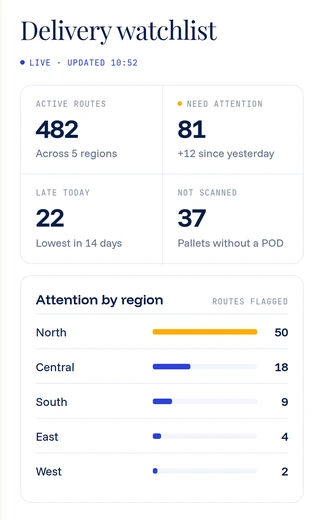
Live dashboards
Every route, every region, updated as it happens. Paloma flags what needs attention before it becomes a problem, so nothing slips through on a busy day.
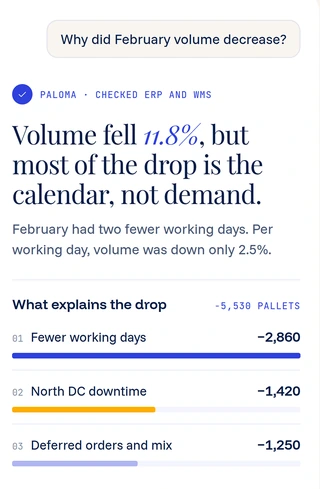
Ask, in plain language
Ask a question the way you'd ask a colleague, and get a straight answer sourced from your own systems — with the reasoning shown, not just the number.
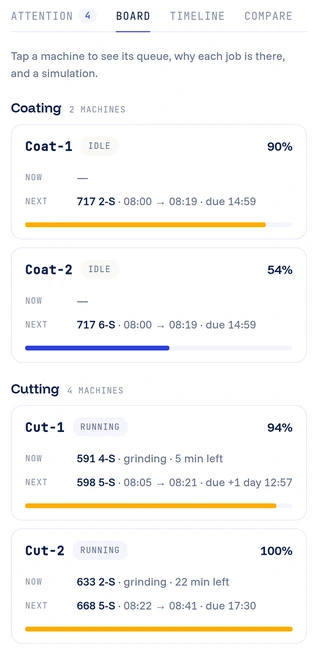
Machine board
Every machine's queue, in order — what's running, what's next, and why. The same live board your team works from, not a report about it.
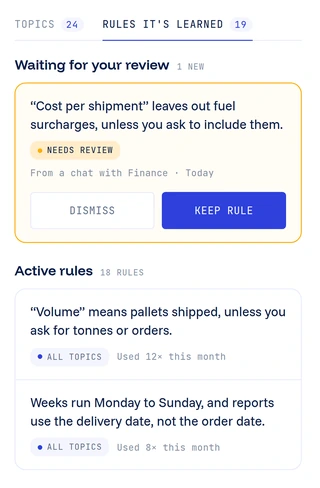
It learns your rules
Paloma picks up on how your team actually works — what "volume" means, which week starts when — and checks with you before it assumes anything new.
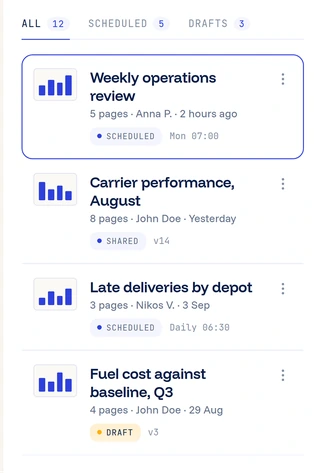
Reports that build themselves
Scheduled, shared, or still in draft — every report your team relies on, generated and delivered on time, without anyone chasing it down.
04 / Proof

“Between wasted logistics spend and time lost to reporting, we didn’t know how much money was walking out the door every month.”
$300K+/yr
Wasted logistics spend
$270K/yr
Margin lost to errors
3 days/mo
Spent on reporting, per operator
Not sure where to start?
Book a demo →That’s what the diagnostic call is for. Free, under an hour. Bring us the mess and we’ll untangle it together.
“I can’t quite put it into words yet” is a fine place to start. You talk, we listen, and at the end you get an honest answer on whether a Speedrun week is worth it. If it isn’t yet, you’ll leave knowing exactly what to do first. You’re not behind. The map just hadn’t been drawn for companies like yours.
05 / FAQ
Questions we hear a lot.
How is this different from hiring consultants or a dev shop?
Our pricing is based on what we build, not how long it takes — so our incentive is to deliver fast, not to extend the engagement. You get functional tools within weeks, not a report after months.
We already use RPA and ChatGPT — what’s different?
Both are real progress, but each has a ceiling. RPA handles isolated tasks well but struggles with flexible, end-to-end workflows and breaks easily when systems change. ChatGPT generates content effectively but can’t move data between systems or take action on it. Paloma is integration software that understands your whole workflow, routes information where it needs to go, and executes the actions itself.
Will it disrupt our existing operations?
We build on top of your current systems, not instead of them. We start with read-only access and build in parallel — your regular operations continue unchanged until the new tool is ready and your team has validated it themselves.
What about data security?
We sign an NDA before touching any data, and access permissions are agreed and documented up front. During the pilot we work with read-only access — every output is an export or a report, never a write back to your ERP. Your IT team reviews the full access framework before anything begins.